
Following the success of the first edition in Belgium (2023), the Power to the Peatlands conference returns for its second European edition. This year’s event, themed ‘Back to the Future: imagining tomorrow, acting today', was organised by Natuurmonumenten, Natuurpunt and Radboud University. Scientists, policymakers, conservationists and rewilding practitioners exchanged new knowledge and experiences regarding the day-to-day practice of management, ecosystem restoration, environmental management and policy implementation in peatlands. The talks are available to watch online.
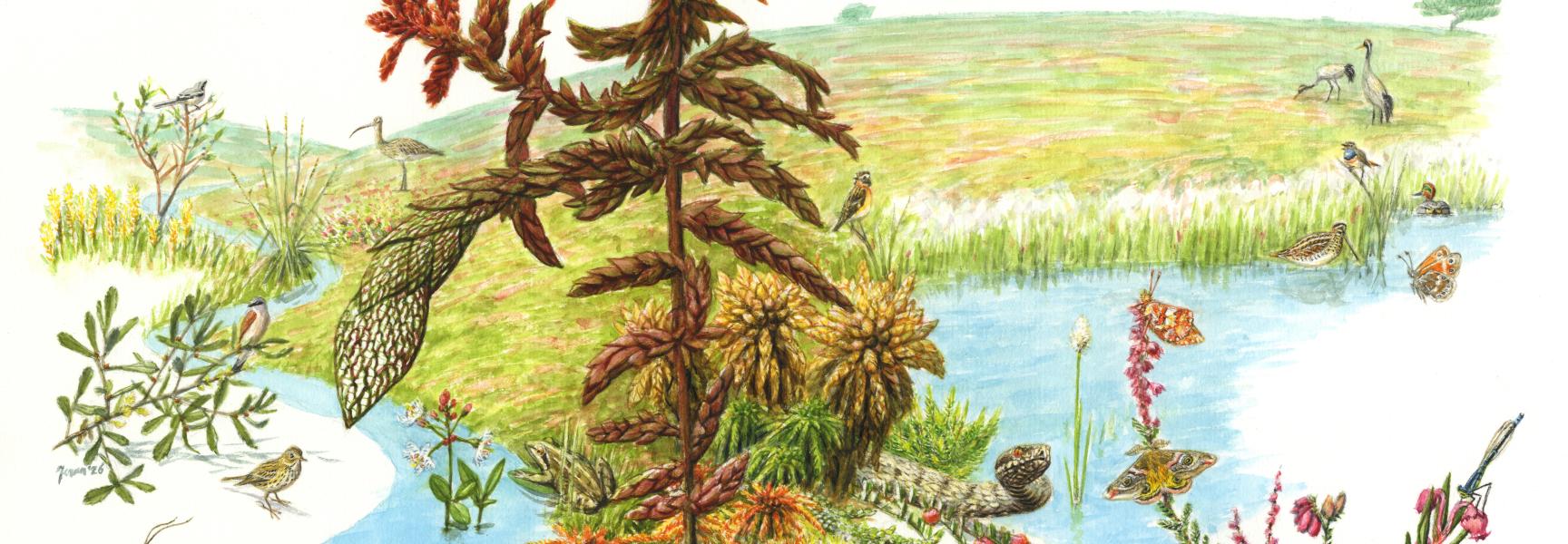
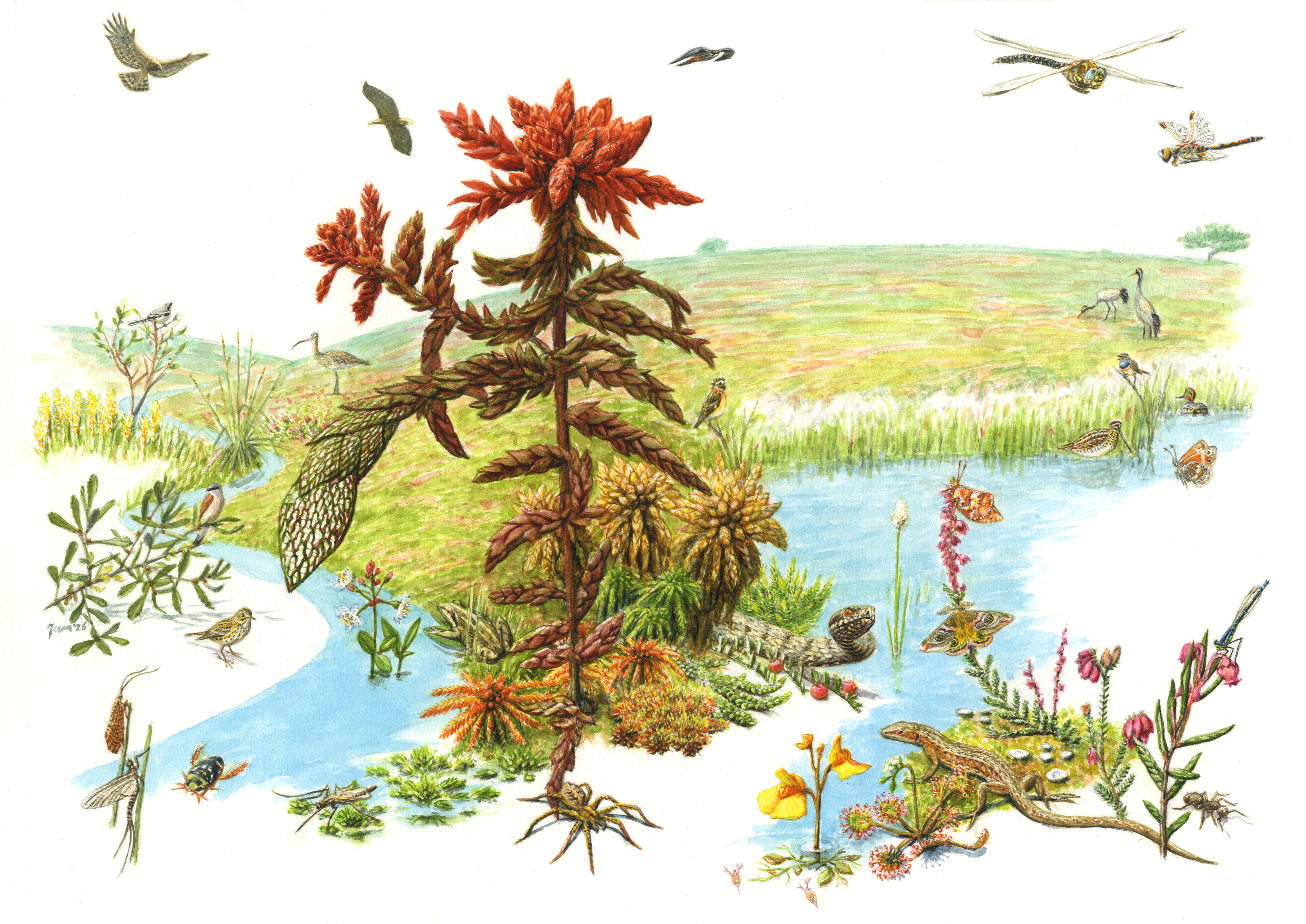
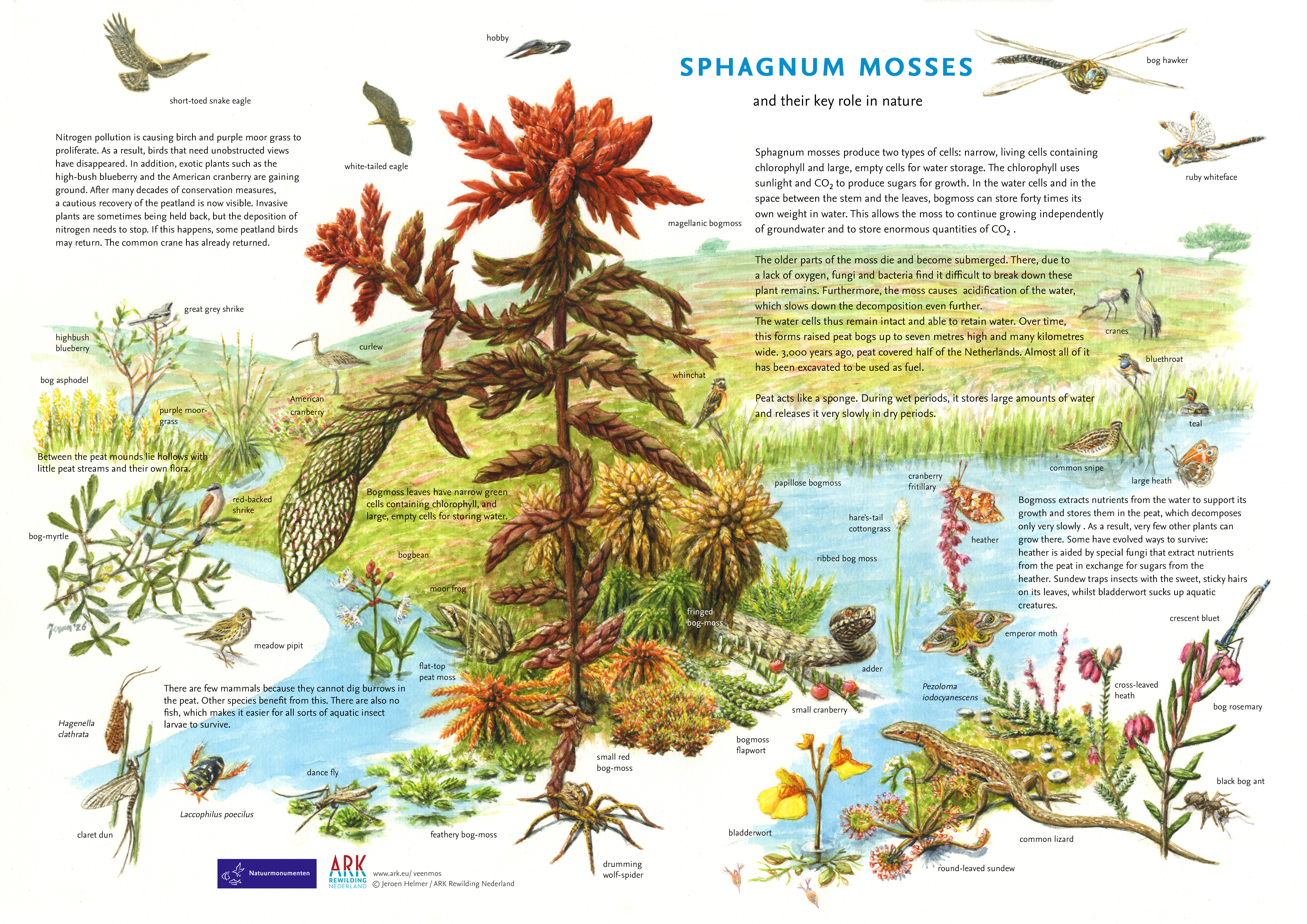
Helmer created this drawing in collaboration with Jacob de Bruin of Natuurmonumenten. The illustration can be downloaded free of charge, for non-commercial use, provided the following credit is given: Illustration: Jeroen Helmer, ARK Rewilding Nederland in collaboration with Jacob de Bruin, Natuurmonumenten. (For the Dutch version and the version without text, click here.)
The power of sphagnum moss
Initially, this tiny plant requires damp conditions, but as it develops, the moss creates its own damp environment, provided there is sufficient rainfall. With its water supply to hand, it can therefore spread into drier areas. Consequently, three thousand years ago, for example, well over half of the Netherlands was covered in peat. Much of this was raised bog, formed by sphagnum moss. Sphagnum moss was able to achieve this remarkable feat thanks to its exceptional structure. Its leaves consist of two types of cells: narrow, linear cells containing chlorophyll and large, hollow cells that store rainwater. It also stores water between the stem and the leaves, enabling it to retain twenty to forty times its own weight in water. This allows it to continue growing independently of groundwater. The old parts of the plant die off, but because these are submerged and the sphagnum moss also causes the water to become more acidic, they decompose much more slowly than new peat is formed. In this way, the structure remains largely intact and the peat retains its sponge-like function. In winter, the peat is at its wettest, causing it to expand, whilst in summer much of the water evaporates, causing it to shrink again. We refer to this annual cycle of expansion and contraction as peat respiration.
Growing over your dead self
There are more than thirty species of sphagnum moss in the Netherlands. The main hummock-forming species are papillose bogmoss, magellanic bogmoss and small red bog-moss. Elsewhere in Europe, brown peat moss plays an important role in hummock formation. The cushions that form – because sphagnum moss can continue to grow on its own dead matter – can reach heights of up to seven metres and span kilometres in width. On these hummocks, lakes – known as ‘meerstallen’ – can form, whilst between the hummocks there are wet depressions with small peat streams. At the edges of such a peat hummock complex, where the more nutrient-rich groundwater exerts its influence, so-called lagg zones develop.
Living alongside sphagnum moss
Because the peat extracts nutrients from the water for its own growth, very few other plants can grow there. Yet some manage to survive through clever adaptations or with help from others. Bog-myrtle, for example, has root nodules that form a symbiotic relationship with bacteria capable of fixing nitrogen – an important building block for plants – from the air. Heather works in partnership with specialised fungi that manage to extract nutrients from the dead peat in exchange for sugars. Sundew has sweet, sticky hairs on its leaves that attract insects, but also trap and digest them. Bladderwort has underwater cups with a hairy lid. The plant creates a vacuum inside the cup and, when the hairs on the lid detect a moving aquatic creature, the lid curls open and the creature is sucked inside.
Plants such as Bog haircap moss grow on the hummocks, along with many dwarf shrubs such as heather, cross-leaved heath and bog rosemary, and occasionally crowberry. Here and there stands a bonsai-like Scots pine. Other plants found here include round-leaved sundew, small cranberry and hare’s tail cottongrass. In the hollows, we find feathery bog-moss, flat-top peat moss, white beak sedge, oblong-leaved sundew and common cottongrass. As mammals find it difficult to walk on the peat, cannot find sufficient food there and are unable to dig burrows in the peat, there are few ground-dwelling predators. Ground-nesting birds, such as the whinchat, golden plover, snipe, crane and curlew, benefit from this. There are also no fish in the lake pools, so the larvae of all manner of aquatic insects, such as dragonflies, damselflies and caddisflies, have a better chance of survival. The acidic and nutrient-poor conditions mean that numerous bog-specialist species are found here, which are absent elsewhere.
A landscape out of balance
Peat has been extracted since Roman times. By digging ditches, the peat was drained, making it suitable for arable farming. From the Middle Ages onwards, people also began cutting and drying peat to use as fuel. The vigour with which this was undertaken and the enormous scale of the extraction did indeed contribute to the unprecedented economic growth of the Netherlands in the 17th century, but it also seriously disrupted the balance of the landscape. The shrinking peat enabled the sea and the major rivers to encroach, causing the peatland landscape to sink below sea level. If the peat water turns brown, this is a sign that the peat is breaking down due to desiccation, usually caused by water extraction for agricultural or forestry purposes. Peat water should be clear. The breakdown of peat is accompanied by significant CO₂ production and now accounts for 4 per cent of national carbon emissions.
Disturbance of the peatland has contributed to nitrogen-loving plants such as purple moor grass, birch, willow and non-native species such as American cranberry and highbush blueberry easily gaining a foothold. Due to the proliferation of these taller plants, ground-nesting birds can no longer see out of their nests. Waders such as the golden plover, wood sandpiper and black-tailed godwit have left the peatlands partly for this reason. Fortunately, following many decades of measures to retain water, signs of peatland recovery are now visible in some places. The crane has returned, and who knows – perhaps others will follow.
Visible recovery in some places
Whinchats nest in small hollows, including those left by the hoofprints of horses or cattle. These animals graze on the edge of the lagg zones. The peat itself is too unstable for the grazers, and moreover, there is too little food to be found. All sorts of snakes, however, are at home in the peat: grass snakes, smooth snakes and adders, which hunt, amongst other things, the moor frogs and common lizards commonly found there. In turn, the snakes fall prey to the short-toed snake eagle, which – partly due to climate disruption – is advancing ever further north. Even the white-tailed eagle now nests near the peat bogs, where it hunts the greatly increased numbers of greylag geese. Finally, the hobby carries out its spectacular hunting flights amongst the abundance of dragonflies above the peat bogs.
Jeroen Helmer has been an illustrator at ARK Rewilding Nederland since its foundation thirty-seven years ago. His narrative illustrations are used all over the world by scientists and people putting rewilding into practice, and have been translated into fourteen languages. Jeroen Helmer is also the author and illustrator of the book Wildernis in Eigen Land, in which he demonstrates that nature is not just about species, but rather about what happens between those species. The book won the Publieksprijs at the 2025 Nature Book Prize (organised by De Volkskrant, Vroege Vogels and Landschappen NL).
